Short answer: Cam Ranh Airport offers free Wi-Fi in all areas of the terminal, 24 hours a day, with free charging points beside it — the international terminal operator states both on its own facilities page. The network name is published only inside a QR code on that page — it is Cam Ranh T2 Free Wi-Fi, with no password — which is why most guides quote something else. If your plan is to land, connect and order a Grab, book the car while you are still inside the building: coverage is built for the terminal, not for the far end of the car park.
What the airport actually promises
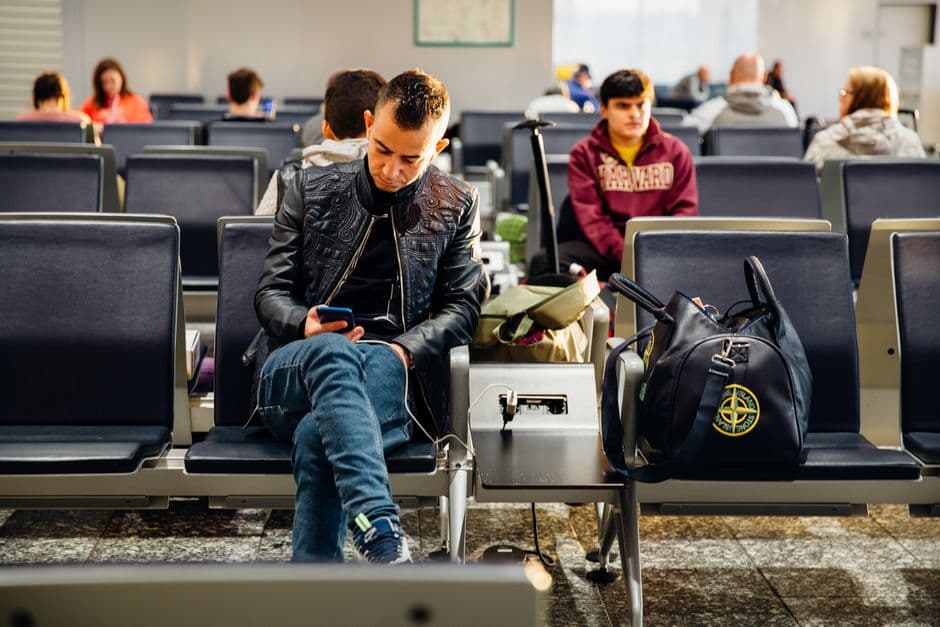
The operator of the international terminal lists free wireless LAN service as available in all areas of the terminal, describes it as high-speed with terminal-wide coverage, and marks it as a 24/7 service. The same facilities list includes free charging stations throughout the terminal, also 24/7, supporting USB and wireless charging, and designated smoking zones in both air-conditioned and open-air form. For an airport of this size that is a generous list, and the charging part matters more than travellers expect: a phone that lands at eight percent battery is the real reason people fail to order a car, not the Wi-Fi.
The network name is published too — just not as text, which is why most guides get it wrong. On the same facilities page the airport prints a Wi-Fi QR code, and the standard connection string inside it reads: network Cam Ranh T2 Free Wi-Fi, no password, not hidden. Note the T2: that is the international terminal. Third-party guides name at least three other identifiers for this airport and contradict each other, so ignore them.
What the airport does not state anywhere is a session limit, a speed in megabits, or what the login screen looks like, and we are not going to invent them. For the domestic Terminal 1 no official network name is published either, so there the old rule still applies: look for a network containing "Cam Ranh" or the airport code CXR, and treat anything else as someone's mobile hotspot.
Terminal 1 and Terminal 2 are not the same experience
Cam Ranh runs two terminals. Terminal 1 handles domestic flights and works with the Vietnamese carriers — Vietnam Airlines, VietJet Air, Bamboo Airways. Terminal 2 handles international arrivals and departures, and it is the newer, larger building where most foreign visitors land. Both have free Wi-Fi. Travellers consistently report that the international terminal holds up better when several flights land together, which is exactly when you want it.
That gap matters on a specific day: a connecting passenger who arrives internationally into Terminal 2 and flies onward domestically from Terminal 1 changes buildings, and the network you were using does not follow you. Check anything time-sensitive — a boarding pass, a hotel address, a driver's phone number — before you leave the terminal you are in. Our guide to the Cam Ranh terminals explains how the two buildings relate to each other.
How to connect, and what to do when the sign-in page will not load
Open Wi-Fi settings, pick the airport network, and wait for the sign-in page to appear by itself. If it does not, the usual cause is a captive portal that your browser refuses to open over an HTTPS address. Two fixes work almost everywhere: turn off mobile data first, so the phone stops quietly preferring your roaming connection, and then open a plain HTTP page in a browser to force the portal to appear. Some reports mention a sign-in by phone number or a social account at Vietnamese airports; if you meet that screen and you have no working number yet, this is the moment the whole plan stalls.
That is the honest limit of airport Wi-Fi anywhere: it is designed for people waiting inside the building, not for people walking out of it.
The situation that actually decides your evening: ordering a car
Most arrivals at Cam Ranh are heading to Nha Trang, about 35 km and 45 minutes up the coast, and most of them want a Grab rather than the taxi rank. Grab needs a live connection at the moment you order, and again when the driver calls to find you. Terminal Wi-Fi reaches the arrivals hall; it does not reliably reach the far end of the car park where ride-hailing pickups happen.
So the sequence that works is: connect inside, order inside, walk out with the booking already placed and the driver's details on screen. The sequence that fails is: walk out, discover no signal, walk back in. Our comparison of Grab and the airport taxi rank at Cam Ranh explains which one is cheaper at which hour, and our guide to a late-night arrival covers what happens after about 22:00, when the last Bus 18 to Nha Trang has gone at 21:55 and the fixed-fare taxi rank becomes the realistic option at roughly 350,000 to 500,000 VND.
When to skip the Wi-Fi entirely
Two cases. First, if you are arriving late at night, when you have little patience for a portal that will not load and a driver who cannot reach you. Second, if you are staying more than a couple of days, because you will want data on the beach and in Nha Trang anyway, not only in a terminal.
In both cases the answer is a local SIM or an eSIM, and the eSIM is the version you can activate before you land, while you still have your home connection. Our page on SIM cards and currency exchange at Cam Ranh Airport covers where the counters are, what they cost and what to skip; the short version for a night arrival is that counters keep daytime hours, so buy your connectivity before the flight or plan to sort it out in Nha Trang the next morning.
Charging while you wait
Free charging points are part of the same official facilities list, available around the clock, with USB and wireless options. They are more useful than they sound on a layover: Cam Ranh is not a large airport, seating is limited, and a charging point you can actually sit beside is worth more than a fast network. If you are waiting several hours between flights, our Cam Ranh layover page explains what is open landside and what is worth leaving the airport for.
A short warning about airport networks generally
Open Wi-Fi is open. Anyone on the same network sees more of your traffic than you would like, and an airport is a place where people log into banking apps because they are bored. Use your phone's built-in protections, avoid entering payment details on an open network, and prefer your own mobile data for anything sensitive. This is not a Cam Ranh problem; it is true in every terminal on earth, and it is the reason a cheap local data package is a better default than free Wi-Fi.